Wednesday, November 27, 2013

References

Bohn, H. (2011). The economic consequences of rising us government debt: Privaleges at risk. Manuscript submitted for publication, University of California Santa Barbara, Santa Barbara, CA, Retrieved from www.econ.ucsb.edu/~bohn/papers/BohnDebtConsequences.pdf

Castelloe, M. (2011, April 27). Changes in the american family. Retrieved from http://www.psychologytoday.com/blog/the-me-in-we/201104/changes-in-the-american-family

Chantrill, C. (2013). Us national debt and deficit history. Retrieved from http://www.usgovernmentspending.com/debt_deficit_history

Davis, S. (2012, April 13). White males fading among house democrats. Retrieved from http://content.usatoday.com/communities/onpolitics/post/2012/04/congress-democrats-house-minority-majority-2012-election/1

Divorce rate by state: How does your state stack up? . (2013, September 5). Retrieved from http://www.huffingtonpost.com/2013/09/05/divorce-rate_n_3869624.html

Family. 2011. In Merriam-Webster.com. Retrieved November 27,2013, from http://www.merriam-webster.com/dictionary/family

Family life in the 1950s [Web]. (2008). Retrieved from http://www.youtube.com/watch?v=E5bAUO7cEU0

Feldstein, M. (2011). Preventing a national debt explosion. Tax Policy and the Economy, 25(1), 109-144 . Retrieved from http://www.jstor.org/stable/10.1086/658383

Gillespie , D. (1987). Adolescents' attitudes toward women in politics: The effect of gender and race. Gender and Society, 1(2), 208-218. Retrieved from http://www.jstor.org/stable/189948

Gluck Mezey, S. (1978). Does sex make a difference? a case study of women in politics. The Western Political Quarterly, 31(4), 492-501. Retrieved from http://www.jstor.org/stable/447231

Gop 'diversit'y - where are women and minorities? [Web]. (2012). Retrieved from http://www.youtube.com/watch?v=iuzTEV0ElIo


Stewart, S. (2010). The characteristics and well-being of adopted stepchildren. Family Relations, 59(5), 558-571. Retrieved from http://www.jstor.org/stable/40929637

Texas political culture: Demographics and inclusion. (n.d.). Retrieved from http://texaspolitics.laits.utexas.edu/10_5_2.html

[Web Photo]. Retrieved from http://i.huffpost.com/gen/1425531/thumbs/o-POLITICS-DIVERSITY-900.jpg?1

 [Web Photo]. Retrieved from http://mycrazyadoption.org/images/DSC_0179.jpg


Thursday, November 7, 2013

Emerging Issues: Growing National Debt

"I'd rather go to bed without dinner than to rise in debt." -Benjamin Franklin

The national debt is a hot topic lately, this debt has been the cause of many things and is linked to the recent recession. Thousands of houses have been foreclosed, unemployment rates have risen, gas prices and inflation rates have escalated, and the government has had a partial shut down. This website, http://www.usdebtclock.org/, keeps constant track of how much debt is accumulated. It is pretty eye opening when you see how quickly our debt gets racked up. The website also shows a break down of each state and each category that the spending occurs in. When looking at the debt clock it is easy to see why the country is in the state it's in.


http://www.jstor.org/stable/10.1086/658383

This journal article puts it's focus on how we could try and prevent a national debt explosion. The article focuses on some of the fiscal problems the debt has created and ways we can try to mend the problems the debt has forced us into. The article begins by taking a look at the current situation we are in economically and the current economic outlook and the risks we take. To counteract the risks that we face, it also talks about three steps that people can use on an individual level to help regain financial stability and get themselves out of debt; these steps are: 1. Stop digging 2. Use mixed financing and 3. Reduce tax expenditure.


This video is very eye opening, it puts the debt onto a personal level and puts it in the perspective of if the debt was yours and if you as a viewer we're having to pay it off and manage it. 
 
http://www.usgovernmentspending.com/debt_deficit_history

This article focuses on the history of our deficit and shows how the deficit has grown and changed since 1900.

 www.econ.ucsb.edu/~bohn/papers/BohnDebtConsequences.pdf

This last article talks about the consequences that we could be facing with the rising debt costs. Some of the topics include the government as a financial intermediary, the challenges of managing our expectations, and conventional macroeconomic effects. The article concludes with giving reasons for why we need to work towards keeping our national debt low.

Family

Family makes up a huge institution in many different societies and like everything else they have changed and adapted. Divorces used to be unheard of, kids rarely had to go between two parents and divide their time, unlike in today's society where divorces are commonplace. The perfect American family from the fifty's is no longer the image when people think of families. The image of a family has drastically changed, there are single parent families, blended families, families with adopted kids, and even families who aren't necessarily related by blood but still live together. Webster's dictionary gives a few definitions of the word family, 1."A group of individuals living under one roof and usually under one head" 2. "A group of persons of common ancestry" and 3. "A group of people who are related to each other". All of these definitions can conjure up an image of different types of families, but no one would question the fact that each of these three definitions adequately describes a family.


This photo is a great example of an atypical family, you have the married parents and their three kids, and then you have the two kids that were adopted into their family.

http://www.jstor.org/stable/1018513

The link above is a very interesting journal article. It was written in the thirties and talks about what the typical family looked like back then, it gives definitions of different types of families such as the social and economic families. The article also includes charts that compare different types of families and various geographical locations to show what on average the typical family looked like.


http://www.jstor.org/stable/40929637

I chose the article above because it is the write up from a survey done to investigate the well-being of stepchildren who have been adopted by a stepparent. This study compares these children with those who have two biological parents, two adoptive, or one biological and one step parent. The study found that the characteristics were dependent on the age of the child, younger adopted stepchildren are most similar to children with two biological parents, but older adopted stepchildren were most similar to non-adopted stepchildren. The study also found that adopted stepchildren of all ages have significantly more behavioral and emotional problems than children with two biological parents, although when it comes to school and education there weren't many differences.


This short video is kind of interesting, it is a depiction of what life was like in the fifties, it focuses on family life and the social life for high school age students.

http://www.huffingtonpost.com/2013/09/05/divorce-rate_n_3869624.html#slide=2111

I included the article above because it shows the divorce rates for most of the states, it also has the top ten countries with the highest divorce rates; the US ranks number 6.

http://www.psychologytoday.com/blog/the-me-in-we/201104/changes-in-the-american-family

This last article is from Psychology Today, it is about the changes in family dynamics since 1960. The main focus of the article is placed on the kids and the marriages themselves and the many changes these family dynamics have undergone.

Thursday, October 24, 2013

Politics and Economy

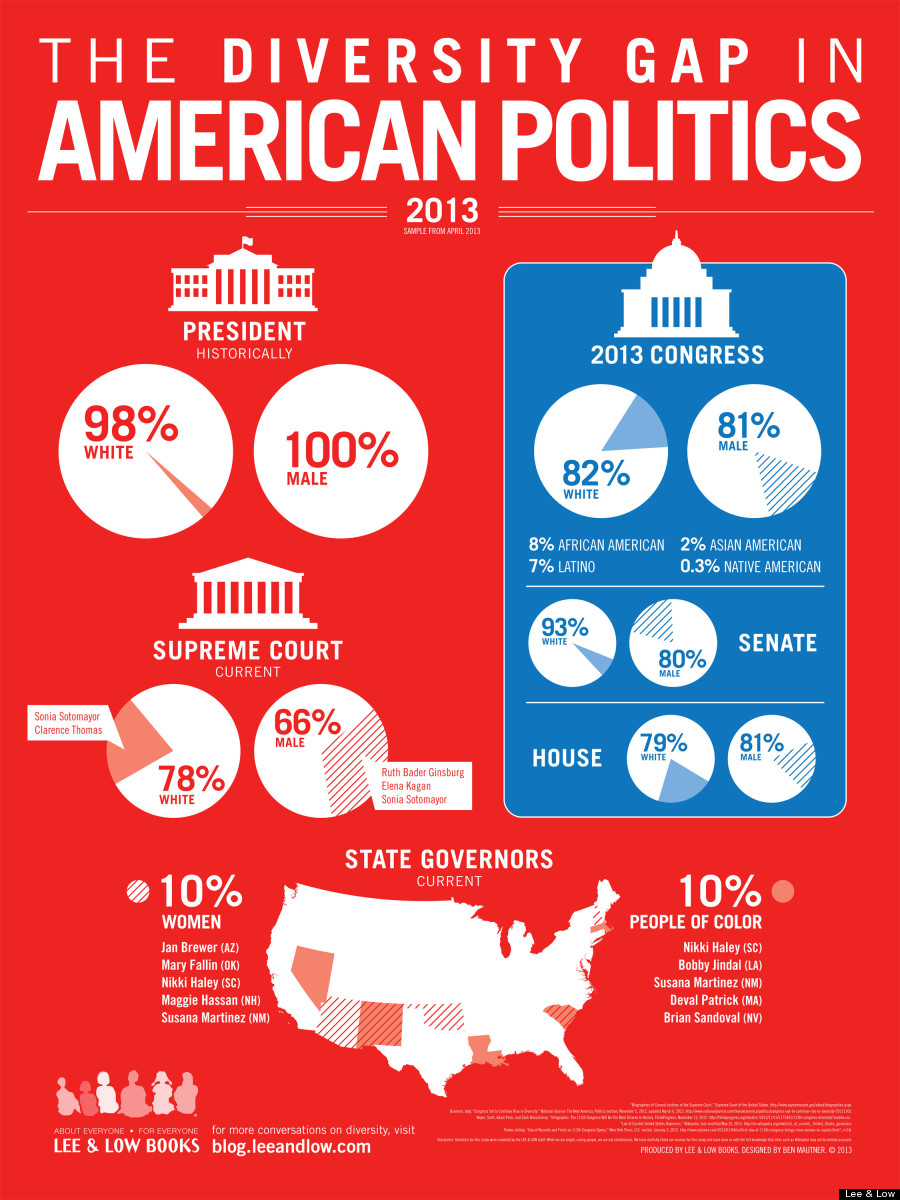
Clearly politics and the economy are both very vast topics that could include many different things. Some of the sub categories in these topics could include things ranging from state, federal, and local government, authority and power, global economy, the labor force, and even to how these things are affecting societies. I chose to put the focus of this blog post on the diversity in politics and power position. The United States has become quite a diverse place, yes we are still predominately white, but we definitely have many different cultures and ethnicities represented; even still, when looking at politics and the government power houses this diverse culture is not represented.


The photo above shows just how little diversity there is when it comes to the power and government of the United States, this is especially proven with the House, Senate, and Governors statistics.
 
 
This first article is from quite awhile ago but it still holds true in today. The main focus from this journal article is that the absence of women in politics is a deterrent to the politicization of girls. The article goes on to talk about a survey taken about how people felt about a woman becoming president and most people were pessimistic about the idea of this happening. This article is still relevant today because although people may not outwardly say it, they are still critical about whether or not a woman would and could be president, or even that women would do well in congress or other power areas.
 
 
 The second article is a case study of women in politics and the struggles and biases they face everyday while in office. The article goes on to find evidence leading to how women and their families are affected while they are serving their terms in office. Another focus of the article is how women are perceived during their time in office and throughout their involvement in politics.


I chose to include this video because it talks about the lack of women and minorities in congress, and the problems that come along with it.
 
 
The website above is from the University of Texas, like the other articles from this post, it discusses various demographics in politics. The difference with this article however, is that it talks about the differences on a more local level, focusing on the state of Texas, and all minorities as opposed to just women.


This article comes at the topic from a very interesting angle; instead of focusing on how the minorities are hindered and face challenges, this article focuses on how minorities are becoming more common and how white males are becoming less prevalent in the House Democrats. This article serves as a reminder that although women are making slow progress, it is still being made and women are gaining more positions when it comes to politics.

Sunday, October 13, 2013

Introduction

My name is Kylie Johnson and I am currently a sophomore at the University of Idaho. I am majoring in Sociology with an emphasis in Criminology and my minor is in Political Science. I am member of the sorority Kappa Alpha Theta and I am also a member of Air Force ROTC. I am hoping to obtain a pilot slot with the Air Force after graduation. Sociology is appealing to me because I like to learn about the idea of community and how people interact. I think it's interesting how many factors can go into decision making for one individual. I am particularly interested in the section pertaining to Politics and the Economy, but another category that I am very interested in is Family and Religion.
 
 
I chose this particular photo to represent Sociology because it shows many different types of people from many different backgrounds and society's and this is the essence of Sociology. Different societies, people, and cultures all play key roles in our world. I think it is important how every individual makes up a part of the whole picture, and I think Sociology helps people work toward understanding that connection between different people.
 
"A moment's insight is sometimes worth a life's experience."
-Oliver Wendell Holmes
 
This quote seems to embody the idea that we "live and we learn", while it is hard for every person to live through experiences and learn from those, I feel that Sociology can help fill in some missing experiences with insight to give us the tools to learn valuable life lessons to gain life skills and experiences.